Constructive Innovation Review and Adaptation Process
White Paper
NOTICE: This white paper was first published on 2026-05-08 in the Ars Technica Architecturae Substack. Starting from November 2026 the stenback.eu is the authorative source for the CIRAP white paper.
This is still a work in progress.
TERMS AND ABBREVIATIONS
- CIRAP
- Constructive Innovation Review and Adaptation Process.
- TRL
- Technology Readiness Level, a nine-point scale describing how far a technology has matured, from basic principles through to a product on the market.
1 INTRODUCTION
There are many definitions for an innovator, but I like to think innovators as people who are proactively two steps ahead of most others. The first step is to identify a problem, a need or an opportunity; the next step is to come up with a solution proposal. However, it is the third step that is often the hardest: explaining the solution to people who might not even be aware of the problem and who are disinterested, especially when they have their own problems to deal with.
This is a common situation in professional settings, when someone has an idea and would like to present it to their colleagues, managers or customers for consideration. More often than not, these people are preoccupied with their own concerns. Failing to grasp the underlying issue, they may dismiss the proposed solution without much consideration.
There are other reasons why ideas and proposals may fail to gain traction, such as interpersonal relationships, organisational hierarchies, personal reputation (or the lack thereof), missing or overly complicated innovation processes, and various cultural influences.
When an idea is ignored, a potential business opportunity is lost.
Organisations employ people who are subject matter experts in their respective fields and areas of responsibility. By enabling and empowering these individuals and teams to describe the problems, needs and opportunities they have identified, and by giving proper attention to the solutions they propose, organisations can tap into a valuable resource for process improvements, new product and service ideas, and other ways of reducing costs or generating revenue.
Unfortunately, all too often these individuals are overlooked when they make the extra effort to step up for the benefit of the organisation, their colleagues and their customers.
There is also another dilemma frequently faced by those with ideas: is it more important to solve the problem or to receive credit (and a potential reward) for solving it?
Many people become disillusioned and demotivated in their work. Although they can identify problems, needs and opportunities – and even have ideas for addressing these issues – they may choose not to bring their ideas forward. This is not only a great loss for organisations but even more so for the individuals who could achieve much more by realising their potential and adding greater value to their work communities.
This is the ground from which the Constructive Innovation and Adaptation Process (CIRAP) grows, striving to provide a solution. In this white paper I will explain my reasoning behind the need and design of this proposed innovation process, which I believe will treat fairly both the innovators and the organisations, in an attempt to foster healthier and more productive innovation culture. My hope is to see innovators achieve greater fulfillment by combining their passions with their work life, and organisations becoming more productive by discovering and realising new opportunities.
2 THE CONSTRUCTIVE INNOVATION REVIEW AND ADAPTATION PROCESS (CIRAP)
CIRAP is a structured, incremental process focusing on three primary objectives:
- to review an innovation proposal on its own merits,
- to provide constructive feedback and support as proposals are reviewed and revised,
- to place suitable emphasis on recognising innovators for taking initiative and delivering value to their organisations.
CIRAP takes an innovation proposal through stages of review and revision, guiding it to evolve from an idea into a potentially commercialisable product, service or process.
The initial review is conducted anonymously to ensure that the evaluation focuses solely on the merits the idea, (ideally) free from biases related to interpersonal relationships or authority dynamics, and similar subjective factors. As the proposal advances through decision gateways, the author(s) are recognised and rewarded for their contributions. Should the proposal be rejected, they retain the rights to their idea.
An initial proposal is an informal document, which must include at least the following four items:
- A description of a problem, a need or an opportunity
- A description of stakeholders, who they are and how they are affected
- A description of the proposed solution
- A description of envisioned benefits following the implementation of the proposal
The initial proposal is never rejected on the first review. The initial proposal is not expected to be a fully viable commercial plan or refined technical design; it is simply an idea. The process of constructive feedback allows the author(s) to refine their thinking, address overlooked issues, and to provide support for their professional development.
Proposals are reviewed by a review board, which is a multi-disciplinary group of organisational representatives. The multi-disciplinary nature of the review board is crucial: it should include individuals with technical, commercial, legal, managerial, human-resources, and other relevant backgrounds that align with the organisation’s business area. Additionally, the review board is guided by the organisation’s long-term strategy, an understanding of current operations, and specific instructions from the organisation’s leadership.
After the first review and comments, the author(s) are invited to submit a revised proposal, which is expected to address issues and answer questions raised during the initial review. The review of the revised proposal is the first pass-or-fail gate in the process.
From here, the proposal will become increasingly more sophisticated in design, followed by technical prototyping, commercial evaluation and final decision on various ways of moving forward. Even if a proposal is rejected at the first gate, the effort is never wasted! Constructive feedback enables the author(s) to improve their ability to identify problems, needs, and opportunities, and enhances their skills in presenting solutions. It also helps organisations review and evaluate business opportunities, reassess their needs, goals, and strategies. Additionally, it enables them to appreciate the broad talent, initiative, and positive attitudes within their workforce.
When an organisation rejects a proposal at any stage of the process, it effectively declares that the idea holds no value to them. Therefore, the intellectual property rights of the initial proposal are returned to the author(s); if the author(s) choose to pursue their idea independently, they must be allowed to do so. This principle is vital for maintaining the motivation and willingness of creative individuals to present their ideas.
On the other hand, when a proposed idea is accepted and ultimately implemented, the author(s) expect to be recognised and rewarded for their contribution in a manner that reflects the value their insight brings to the organisation. Otherwise, they may feel exploited and undervalued, losing interest in making further contributions.
With these processes in place, CIRAP ensures that every proposal is given fair consideration, and that innovators are either rewarded or empowered to pursue their ideas independently.
3 GUIDING PRINCIPLES
Principles are not dogmatic: they offer guidance and are intended to be applied as best suits the present context, intent and situation. Principles can be ignored, but they should always be considered.
3.1 Psychological Safety
“Psychological safety is being able to show and employ oneself without fear of negative consequences of self-image, status or career.”
When a person steps forward to present an idea beyond the immediate scope of their job description and responsibilities, the person may feel emotionally exposed to criticism, rejection and ridicule. To discourage and demoralise creative thinkers willing to take initiative and promote the common good simply isn’t helpful.
When people feel safe to share their ideas without fear of criticism, trust builds naturally. This trust is the foundation for effective teamwork, knowledge sharing, and overall workplace success – and perhaps more importantly, it encourages people to direct attention to risks and to bring into light negative aspects in their work environment. A culture of psychological safety not only fosters collaboration and innovation but also supports continuous learning and self-improvement. It encourages teams to engage in self-organisation, embrace cooperative efforts, and explore new ideas through research and development.
As part CIRAP, psychological safety strives to encourage individuals to take initiative and bring forward their ideas and insights. It will also make it easier to receive constructive feedback as well as to deal with rejection by presenting them as learning opportunities so that they could do better the next time around: a rejected proposal should never be perceived as something that negatively defines the person(s) who made the proposal.
It is equally important for person(s) to understand how the decisions of the review board are made, and how they are based on organisational goals and guidelines; these are in place to evaluate proposal’s value to the organisation, and should not be perceived as acts of personal judgement.
3.2 Fail-fast and Learn from Experience
“Fail fast, fail often” is a familiar mantra in Silicon Valley.
Fail-fast as a business principle suggests that instead of moving slowly and carefully towards new business venture, organisations should instead undertake bold, focused experiments to see what works and be willing to accept failures as learning experiences.
There is an unfortunate stigma associated with a concept of “failure”; that it is something to be avoided and worse, sometimes people are punished because of it.
All failures, no matter of definition, are opportunities to learn and improve.
- Even if we did not find the right way to do something, at the very least we now know what doesn’t work. By process of elimination, we are a step closer to the right solution.
- Even if a project is ultimately a failure, there might have been things that did work. Identify what was good, adopt things that worked, reject the rest and move on! In the next project apply previously learned skills and knowledge instead of attempting to reinvent the wheel.
Good ideas fail all the time for variety of reasons. So, when working in a project, be it for research or development, evaluate the progress regularly and don’t be afraid of terminating the project when success is no longer a realistic option. However, when a project is terminated, keep in mind that it was truly a failure only if nothing new was learned from it.
Failure is always an option.
3.3 Minimum Viable Product
A minimum viable product (MVP) has just enough features to be usable for early adopters and stakeholders, who can provide feedback for future development. MVP mindset helps to focus limited development resources to identify what is essential, and to produce a result that provides value from the very first iteration. Early feedback from stakeholders provides guidance when making decisions for the next developmental steps.
Research and Development is an investment in time, money and resources, with expectations of positive return on investment. With investment also come risks, which must be managed and mitigated. By building a minimum viable product before committing to a full-scale development project, an organisation can take measured steps to investigate the viability of the product, service or process while limiting the risk exposure.
However, it should be noted that a minimum viable product is more likely to fail if key issues are overlooked:
- Product vision and roadmap: a minimum viable product must be based on a vision of a full-scale product, and the implementation of the MVP is just a first iterative and incremental step towards realising that vision. The vision may be clear or hazy, and the roadmap may be detailed or sketchy, but both are needed lest you might lose your way.
- Stakeholder requirements: the purpose of any product, service or process is to provide value to the stakeholders. From this follows that the need, problem or opportunity must be understood in terms of what is expected or required by the stakeholders: a requirement must be unambiguous, measurable, understandable, factually correct, atomic and necessary. The requirements must be prioritised, and MVP should focus on the ones deemed most critical (e.g. without which the solution is either unusable or unnecessary).
- Knowing the difference between facts and assumptions: people assume more than they often realise; a statement is an assumption unless there are facts to back it up. Be mindful of your assumptions, have them documented and re-evaluate them as you gain deeper understanding about the project.
3.4 Retrospective
Retrospective is a process of periodically looking back to identify things which were either positive or negative, and how things could be improved; fix what is broken, utilise all things that are helpful and improve what can be made better. Retrospective is a key method for organisations striving to promote learning, self-organisation, and adaptation.
CIRAP encourages Review Boards to have regular retrospectives with intent to refine their review process and organisational guidelines. It would also be helpful to invite innovators to take part in retrospective so that their perspective would also be addressed: retrospective can provide feedback and learning opportunities not just for the innovators but also for the review board, the process, and the organisation itself.
3.5 Multi-Disciplinary Review Board to Counter Biases
Consider the following: a technically minded person might see a problem that can be fixed, while a business-oriented person might see an opportunity that can be exploited. Both are describing the same case, but their personal background – their Frame of Reference – guides them to describe it from different perspectives. Both can be equally valid, but will they be equally treated?
A person’s frame of reference, which can be understood as the total sum of their personal and professional life experience and is guided by their adopted ethics and morals. It is the context through which they make and justify their decisions, express themselves and strive to understand others.
CIRAP assumes that initial proposals tend to be either technically or commercially oriented. A technically oriented initial proposal might focus more on the description of a problem and the proposed solution while overlooking the business side of things. Similarly, a commercially oriented initial proposal might provide such a generic or a high-level description of a proposed solution that it would not be immediately obvious how the proposed solution should be implemented in practice.
In both cases the proposal might be best evaluated by like-minded peers, but it would take a multi-disciplinary approach to assess otherwise overlooked aspects of the proposal: a technical proposal needs help to address business related perspectives, while a commercial proposal might not be viable without addressing technical perspectives. From this follows that the Review Board should include members representing multiple organisational domains such as management, architects and engineers, sales, legal and HR. Even when a proposal falls outside of a member’s professional field of expertise, their questions and observations are likely to provide valuable perspective that might otherwise go unnoticed or be ignored.
In other words, proposals are written and evaluated through personal frames of reference, which exposes the process to variety of cognitive biases. Consider the following:
- Framing Effect: the same proposal can appear compelling or weak depending on whether it is framed as risk reduction, revenue, compliance, performance etc.
- Maslow’s Hammer / Expertise Bias: reviewers tend to evaluate through the lens of what they know and over-trust signals that match domain (technical elegance, business narrative, legal defensibility and so on).
- In-group Bias / Similarity Bias: “this feels like my kind of proposal / my tribe’s way of thinking”, which boosts perceived quality while ignoring or downplaying the actual merit.
- Authority Bias / Status Bias: Proposals from senior people or “prestige roles” tend to get preferential treatment while others are scrutinised harder.
- Ambiguity Aversion: When something is unfamiliar or cross-domain, reviewers may prefer the safer, clearer, known option from which follows, that novel proposals may be penalised because of reviewer uncertainty instead of any inherent weakness within the proposal.
- Anchoring: Early impressions like “this is too vague” or “this is too technical” can stick and drive the rest of the discussion.
To counter various biases CIRAP recommends that the Review Board consists of people with diverse professional backgrounds, seniority levels and lived experiences with emphasis on psychological safety to challenge assumptions and calcified way of thinking.
3.6 Considering Intellectual Property Rights and Motivation
Many employment contracts have stipulations stating that all intellectual property rights arising from employee’s work belong to the employer. Some contracts are more draconian than others, but the basic principle is usually the same: if an employee comes up with an idea the employer would like to claim ownership over it.
Here’s a question: why should an employee share an idea with their employer that is not directly related to their work at hand? What often happens in various organisation is that when an employee shares an idea the employer claims the IPR even when they have no interest or intent to utilise it. Similarly, when an implemented idea becomes profitable, it is the employer that reaps the benefits while the employee may remain unrecognised or be granted with just a token reward.
From this follows that some employees with valuable ideas may feel unmotivated to step forward and present their proposals if they already feel unappreciated, exploited or have hopes to work on their idea independently. Consequently, these people might only share throw-away ideas that they are not emotionally attached to.
So, would it not be beneficial for the employer to take steps to motivate and encourage the employees with best know-how to share their ideas by rewarding those that bring value to the business while not claiming ownership of ideas that hold no value to them?
CIRAP recommends that
- when a proposal is rejected the IPR returns to the author(s): when the organisation has reviewed the idea and determined that the proposal has no business value, claiming IPR is just spiteful behaviour.
- when a proposal matures to generate revenue or to reduce costs, it would encourage other employees to become more proactive with their ideas if the author(s) are awarded a bonus based on the value generated by the proposal.
3.7 Technology Readiness Levels in CIRAP
Technology Readiness Level (TRL) scale was originally defined by NASA as “a type of measurement system used to assess the maturity level of a particular technology”. This scale was later introduced in EU funded projects in 2012 and is currently the point of reference for determining the development or maturity of research and its readiness for the market update and potential investments. (EURAXESS)
EURAXESS provides the following example for hardware and system technologies:
RESEARCH ACTIVITIES
- TRL 1: Define basic properties
- TRL 2: Analytical study
- TRL 3: Proof of concept
- TRL 4: Pre-prototype
DEVELOPMENT ACTIVITIES AND PROTOTYPING
- TRL 5: Pre-prototype tested in lab
- TRL 6: Prototype tested in relevant environment
- TRL 7: Approved prototype
PRODUCTION CONFIGURATIONS WITH FULLY FUNCTIONAL PRODUCT
- TRL 8: Pre-serial manufacturing
- TRL 9: Product on market
CIRAP primary focus is on TRL levels 1-4.
- TRL 1: Initial proposal
- TRL 2: Formal proposal
- TRL 3-4: Proof of concept
With these phases organisation should be able to determine whether or not the proposal has practical business value. CIRAP can be extended to include also TRL levels 5-7 in the sense that the organisation develops a prototype as MVP and use the final review to determine proposal’s commercial viability and to determine if this is something the organisation should pursue, create a spin-off, sell to an interested third party, or ultimately reject the proposal.
4 ARTEFACTS AND ROLES
4.1 Artefacts
This process recognises five artefacts: (1) Initial Proposal, (2) Revised Proposal and (3) Formal Proposal are documents while (4) Proof of Concept and (5) Prototype can be anything that demonstrates the proposed solution in practical terms.
4.1.1 Initial Proposal
Initial Proposal is an informal document that describes four items: (i) a problem, a need or an opportunity, (ii) stakeholders (individuals, groups, organisations) who are affected, (iii) a proposed solution, and (iv) expected benefits from realising the solution.
Initial Proposal describes the case as the Author(s) see it and it may be either technical or business oriented, but it does not need to be both. It describes key points, provides relevant context, and a starting point for the process. Initial Proposal is never rejected outright but instead Review Board will provide questions and observations so that the proposal may be revised before the first review.
4.1.2 Revised Proposal
This is the final informal iteration of the proposal based on the Review Board’s input. The purpose is to address Review Board’s questions and observations so that the Review Board may make an informed decision on how to proceed with the proposal.
Revised Proposal is an iteration of the original proposal with the purpose of clarifying the case as highlighted by the Review Board. This is the version that will be critically reviewed.
4.1.3 Formal Proposal
Formal Proposal is based on organisation specific template that addresses both technical and business aspects of the proposal. The intent is to normalise proposals to enable reasonable objective evaluation and comparison against other similar proposals.
4.1.4 Proof of Concept
Proof of Concept may be a necessary step if the proposal hinges on some technical aspects that should be demonstrated in practice before committing to building a more substantial prototype.
4.1.5 Prototype
Prototype is a functional, minimum viable product that provides a reasonable end-user experience and can be demonstrated to potential customers. When describing a process instead of a product or a service, for example a BPMN diagram could considered a prototype in this context.
4.2 Roles
This process describes four essential roles.
In addition to the roles described here, it is acknowledged that colleagues, organisation’s leadership, and customers may be involved in some way or another, but they have no specific role in this process.
4.2.1 Author(s)
Person or persons who have identified a problem, a need or an opportunity and are now proposing a solution for it.
It is generally understood that author(s) have a specialised background and as such, while they are well-versed to identify problems and come up with solutions within their own field of experience, no one should expect them to come up with a fully-fledged product design with a mature business plan; they have an idea, and they will need support to further improve it.
4.2.2 Review Board Member
Review Board consists of representatives from various business domains, ideally with diverse personal and professional backgrounds and life experiences. For example, review board members could include people with backgrounds in management, technology, legal and HR. Each organisation will determine what kind of board would make most sense in their context.
It is recommended that there are 3-5 board members, but no more than nine.
A review board member may also be the Author, in which case the anonymity requirement needs to be put aside, and the board member is excluded from the review of their own proposal.
4.2.3 Review Board Presenter
Review Board Presenter is also a member of the Review Board.
As the initial proposals are intended to be anonymous, a point of contact is needed between the Review Board and the Author(s). Any board member may assume the role of Presenter case by case, but alternatively the Presenter can also be considered as the chairperson of the board.
4.2.4 Case Handler
Case Handler may be assigned to support the Author(s) when the Revised Proposal is accepted, and Formal Proposal drafting begins.
Case Handler is a facilitator who knows how to write a Formal Proposal. Case Handler is not one of the Author(s) and does not need to be involved with the actual design work. However, Case Handler, as a facilitator, can help the Author(s) to get in touch with the right people.
5 THE STEP-BY-STEP PROCESS
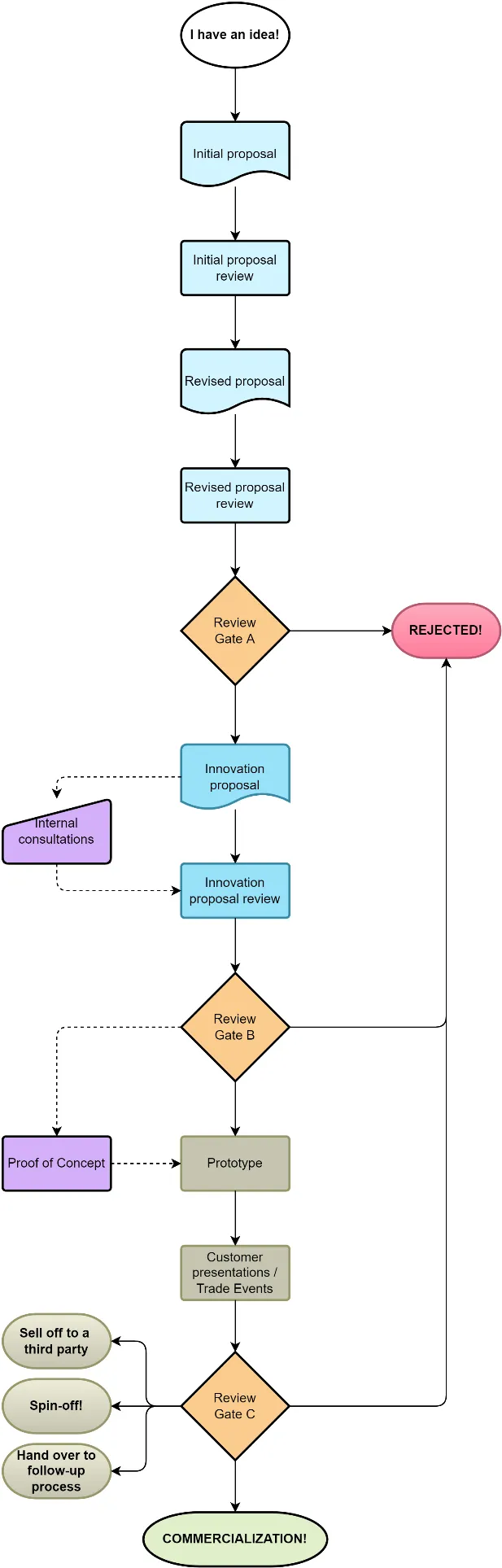
5.1 STEP: Initial Proposal
Initial Proposal is the starting point of the process. It is an informal document that contains four items:
- Description of a problem, a need or an opportunity
- Description of affected parties i.e. stakeholders
- Description of a proposed solution
- Description of expected benefits if the proposed solution is implemented
The Initial Proposal is submitted to the Presenter of the Review Board.
5.2 STEP: Initial Proposal Review
The basic flow for the Initial Proposal Review is as follows:
- Presenter presents the Initial Proposal to the Review Board
- Board members are given a fixed timebox for discussion
- Following the discussion each board member will write down their personal questions and observations about the proposal; the intention is to be constructive and supportive, striving to help the Author(s) to revise their idea further.
- Presenter forwards the input to the Author(s).
- It is up to the Author(s) to decide if they wish to revise their proposal based on the feedback or abandon the proposal.
All Initial Proposals are presented anonymously: each proposal must be reviewed and evaluated based on its own merits and not be influenced by the Author(s) perceived position or reputation (or lack thereof).
At this point it is all about the idea.
No proposals will be rejected based on the Initial Proposal Review: an informal initial proposal may be quite unrefined, but that doesn’t mean the underlying idea is bad. The intent of the Initial Proposal Review is to provide feedback to the Author(s) in the form of questions and observations so that they can up with an improved, revised proposal if they still have faith in their idea.
Be supportive and constructive towards the Author(s): the goal is to support the organisation’s innovative thinkers so that even if their proposal is ultimately rejected, they will be better equipped to come up with new ideas and present them next time.
Presenter is the gatekeeper: if an Initial Proposal is missing some essential information or is otherwise in such a state that it would be counterproductive to present it to the Review Board, the Presenter may instruct the Author(s) to supplement their proposal.
At this stage all communication between the Review Board and the Author(s) goes through the Presenter.
5.3 STEP: Revised Proposal
The Review Board provides feedback in the form of questions and observations. This presents an important opportunity for the Author(s) to consider their proposal from new perspectives.
After reviewing and reconsidering the proposal the Author(s) may decide to revise it according to the questions and observations, but they might also come to conclusion that the proposal is not worth taking further.
The Revised Proposal is expected to provide answers to all questions and otherwise address the various observations.
The Revised Proposal is submitted to the Presenter of the Review Board.
5.4 STEP: Revised Proposal Review
The basic flow for the Revised Proposal Review is as follows:
- Presenter presents the Revised Proposal to the Review Board
- It is recommended to go recap the questions and observations from the Initial Proposal Review phase.
- Board members are given a timebox to discuss and review the Revised Proposal. If necessary, the timebox may be extend to the next Review Board meeting.
- Each board member evaluates the Revised Proposal against the organisational guidelines from their personal perspective: would the proposal support the organisation’s business strategy and long-term goals, or otherwise provide meaningful benefits?
- Review Board members take a vote.
- Each Review Board must determine how it will make decisions at each gateway: will it take (a) a simple majority, (b) a super majority, or (c) a consensus to approve the Revised Proposal for further development?
5.5 GATEWAY: Review Checkpoint A
Following the Revised Proposal Review the board decides to either reject the proposal or promote it to Innovation Proposal.
Proposal is rejected: the related IPR should return to the Author(s), since the Review Board has determined that it has no value to the organisation. This is a process endpoint.
Proposal is accepted: the proposal is promoted to Innovation Proposal, and the Review Board assigns a Case Handler to.
Additionally, Author(s) is granted a fixed timebox and a budget for the preparation of the Formal Proposal. Case Handler will oversee that the work is done within the specified time and budget and facilitates where help is needed.
Finally, CIRAP recommends that a small reward is given to the Author(s) as a recognition for coming up with a promising idea and opportunity.
5.6 STEP: Formal / Innovation Proposal
Innovation Proposal is a formal document that presents both a technical solution as well as a business case for potential commercialisation. Each organisation is expected to determine the document template and content as per organisation’s specific needs and requirements.
For example, the Innovation Proposal might include
- Refined descriptions of the problem, need or opportunity in the form of
- Requirement specifications: business, functional, non-functional and/or information security requirements
- Essential use cases
- “wouldn’t it be cool if we…”
- Refined descriptions of the affected stakeholders including, for example
- Directly involved stakeholders (e.g. users, partners, other teams)
- Technical description of the proposed technical solution including, for example
- High-level system architecture and/or high-level technical specification
- CAD/3D model or an alternative description of a product design
- Refined business case including, for example
- Strategic context
- Economic analysis
- Commercial approach
- Financial case
- Project plan / management approach
This should be done within reason and by adhering to agile design principles.
- Start with what you know, document your assumptions and list your open questions
- It is alright to say “I don’t know” until you find your answers
- While the document has a formal structure (which is to say, these topics should be addressed) focus on the content; say what is needed and avoid unnecessary clutter.
- You know the least when the work begins, and you know the most when work is completed: update your documentation incrementally as your knowledge increases.
Consider following definition of an Information Architect:
“I mean architect as used in the words ‘architect of foreign policy’. I mean architect as in the creating of systemic, structural, and orderly principles to make something work – the thoughtful making of either artefact, or idea, or policy that informs because it is clear.”
In other words, consider what you are describing, to whom and why you are describing it. The documentation matters very little if the target audience doesn’t understand it or see value in it.
The formal documentation also helps to normalise proposals so that (a) a proposal can be reasonably compared with previous and/or similar proposals, and (b) to reduce the level of subjective judgement that is influenced by how information is structured and presented (a minor factor, perhaps, but it is not negligible).
Case Handler’s primary task is to help Author(s) transform their informal proposals into a formal proposal.
5.7 OPTIONAL: Internal Consultations
It should be noted that Author(s), Case Handler and Review Board members come from (more or less) specialised professional background while also being influenced by their personal frame of reference. While they all have general knowledge of issues beyond their field of expertise, expecting too much may result in failure and loss of motivation for all parties involved. For this reason, CIRAP encourages that additional subject matter experts are invited to help with the innovation process when deemed beneficial (within specified timebox and budget).
The contributions of consulted specialists are acknowledged in the Innovation Proposal for two obvious reasons: credit must be given where credit is due, and the know-how of these specialists may be needed in later phases of the process.
Case Handler facilitates and coordinates the internal consultations when they are needed while preparing and/or the Innovation Proposal.
5.8 STEP: Innovation Proposal Review
Innovation Proposal Review is the key point when the organisation must determine if the proposed idea is so promising that it is worth investing time, money, and additional resources. It is expected that most proposals will be rejected at this point, but as long as the Innovation Proposal was well made and considered, the decision should be well-informed.
Review Board is encouraged to utilise Internal Consultations when deemed beneficial. The decision to approve or reject a proposal should be a natural end-result of balanced deliberation; if the decision is forced or rushed, everybody loses, and opportunities and efforts are wasted.
5.9 GATEWAY: Review Checkpoint B
When reviewing an Innovation Proposal, the Review Board has essentially three options.
Option 1: Approve the proposal and promote it into a Proof-of-Concept project.
Option 2: Approve the proposal and promote it into a Prototype project.
Option 3: Reject the proposal and close the case.
Both project types should be assigned with a deadline, budget, and a project manager (or continue the Case Handler’s assignment).
Author(s) should receive moderate reward for their initiative.
5.10 OPTIONAL: Proof-of-Concept Project
Proof-of-Concept project may precede the Prototype project if the proposal has any technical or otherwise specific aspects that should be demonstrated before a commitment for more substantial implementation can be made. Typically, Proof-of-Concept is a technology demonstrator.
Proof-of-Concept does not need to be concerned with usability and end-user experience, information security, performance, or any other aspects beyond the immediate scope of what is required for demonstration purposes. It must provide proof that the key underlying principles, technologies, assumptions and/or theories can be practically implemented and meaningfully utilised.
CIRAP encourages to embrace the principles of
- Fail-fast
- Rapid prototyping
- Agile development
- Lean thinking
The Proof-of-Concept project should have a fixed deadline and a minimalist budget. It needs to have a project manager (or similar role) with a skeleton team (could be just one person) that has the technical know-how for producing the proof-of-concept; whether the team includes the original Author(s) is discretionary.
The demonstration is given to the Review Board, which makes the decision if the proposal is rejected at this point or if it will be promoted to a Prototype project.
5.11 STEP: Prototype
A Prototype project demonstrate the solution as a minimal viable product. As such, a prototype provides a reasonable end-user experience and can be demonstrated to potential customers or partners, be it a physical device, software product or a different kind of service.
The prototype project is assigned with a Project Manager, a fixed budget and a schedule. The development team can be based on the original authors, and it can be supplemented with additional people who have necessary, specialised know-how, but obviously the team composition is determined on a case-by-case basis.
5.12 STEP: Customers / Trade Events
A prototype is an effective demonstrator that can be presented for potential customers directly or for general public in trade events. It must attract reasonable business or consumer interest in order to be considered for a viable business case.
While a prototype cannot be monetised as-is, the feedback from potential customers and/or partners of one variety or another is required when making the final decision.
5.13 GATEWAY: Review Checkpoint C
In the final checkpoint we consider potential business cases and other alternatives.
5.14 RESOLUTION: Commercialisation
Prototype will be further developed into a commercial product or a service for the organisation’s customers. This launches a new product development project with appropriate budget, team and product life-cycle considerations.
The *Author(s)*should receive a major reward for their efforts and the profit they are bringing for the organisation.
5.15 RESOLUTION: Sell Off to a Third Party
While the prototype has commercial potential, it does not fit into the organisation’s business model and/or product or service portfolio. However, there is a possibility to sell off the prototype along with the immaterial rights to another organisation, which is willing to continue with the prototype’s development and commercialization.
The Author(s) should receive a major reward for their efforts and the profit they are bringing for the organisation.
5.16 RESOLUTION: Spin-off
The prototype does not fit into the organisation’s business model and/or product or service portfolio, but it has demonstrated viable business potential. Instead of selling the protype to a third party, the organisation decides to create a spin-off based on the prototype.
The Author(s) should receive a major reward for their efforts and the profit they are bringing for the organisation. Alternatively, the authors may decide to join the spin-off and perhaps get a stake in the new business.
5.17 RESOLUTION: Handover to Next-Level Business Development Process
In some cases, organisation may have additional steps in their business development process, in which case the output of CIRAP will be the input for the next process.
The Author(s) should receive moderate reward for their efforts with expectation to receive a greater reward if the prototype passes the follow-up business development process and ends up being commercialized.
5.18 RESOLUTION: Rejection
The prototype, while initially promising, just is not interesting and compelling enough to generate commercial interest within the company or among the potential customers. There are no reasonable expectations that the prototype could be turned into a successful product, service or business. At least not by this organisation.
It must be noted that a rejection at this point is not a complete loss! Much has been learned, both by the people and by the organisation. By going through lessons learned and introspection exercises the CIRAP process can be further refined, the authors can develop deeper understanding of the organisation’s needs, and the organisation itself may analyse what can be learned about the customers, markets and the organisation’s business development needs.
When a prototype is rejected the IPR of the initial proposal (not necessarily the formal proposal or prototype) is returned to the Author(s). If the author(s) are able to find a way to turn their rejected idea into a viable business case through some other means, they should be allowed to do this. In the grand scheme of things, this would a positive thing for the society and economy, but most importantly it would be significant for the Author(s) both emotionally and morally.